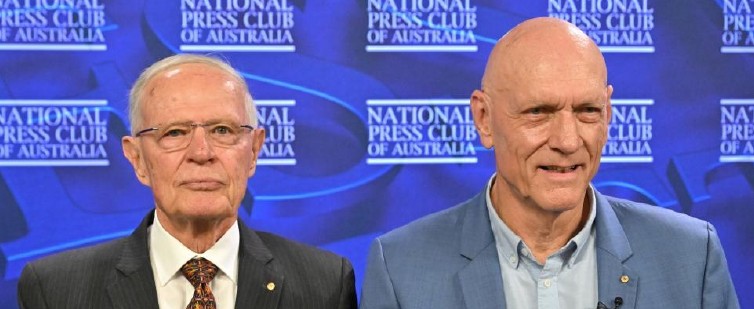
The launch of the AUKUS Public Inquiry’s final report and recommendations, entitled Surrendering Australia: The AUKUS Deception, took place on 4 November 2026 at the National Press Club in Canberra.
Presentations were made by both Peter Garrett and Admiral Chris Barrie (Ret’d), alongside their fellow commissioners, Dr Carmen Lawrence, Karina Lester, and Leanne Minshull.
Peter Garrett’s presentation
Garrett noted that the AUKUS agreement was the biggest defence deal in modern Australian history, worth an initial $368 billion which equates to a staggering $33 million a day for 30 years. He stressed that the figure rises to around $500 billion once roughly $180 billion for radioactive waste management is included.
Garrett also argued that AUKUS entails the “lockstep embrace” of US military interests.
As well, he noted that the Federal parliament never properly debated the AUKUS agreement, which Scott Morrison conceived and Anthony Albanese accepted immediately, and that Labor has not conducted a thorough review of the agreement since taking office.
Hence the setting up of a volunteer-driven, nationwide public inquiry that cost the public purse nothing.
AUKUS’ twin pillars
Garrett briefly described the two primary components of the AUKUS project:
- Pillar 1 covers a US submarine rotational force at Stirling, WA, from 2027, the purchase of three second-hand US nuclear-powered submarines, and up to five new AUKUS SSN submarines built with the UK.
- Pillar 2 covers shared development of technologies such as undersea robotics and AI.
Contributors
Contributions to the public inquiry included military experts, former senior defence officials (including retired Rear Admiral Peter Briggs), Malcolm Turnbull, three former defence ministers, two former foreign ministers, First Nations communities, academics, unions, community groups and the public. Garrett said most submitters argued AUKUS was seriously flawed. The exceptions included former Defence Ministers Beazley, Pyne and Reynolds.
Key findings
Garrett outlined the key findings of the AUKUS Inquiry in the following terms:
- The AUKUS pact is arguably “the worst, most costly and riskiest defence decision ever made by an Australian government,” and lacked adequate scrutiny. Garrett noted that this finding echoed Paul Keating’s “worst deal ever” verdict.
- The submarines have debatable usefulness and may never arrive. The deal also undermines sovereignty, risks prosperity, distorts the defence budget and fails to promote regional peace.
- Australia subsidises UK and US submarine construction with a preliminary budget approaching $9 billion, even though both countries are well behind schedule.
- The HMAS Stirling naval base is becoming a de facto US base, with over 2,000 US troops housed at Australian expense. Garrett said this makes areas like Rockingham and Fremantle likely targets.
- There are no refunds or enforceable obligations on partners. Australia also indemnifies the US and UK against nuclear-related claims.
- There is no costing or plan for safely disposing of high-level radioactive waste, including where it would go. Garrett called this especially galling for First Nations peoples given the history of British nuclear testing in South Australia. He noted that neither the US nor the UK has built a permanent high-level waste facility.
- Other findings cover conflicts of interest as officials move into the arms industry, military-industrial penetration of the education sector, and AUKUS legislation overriding environmental protections and consent expectations. They also include exaggerated employment benefits and the existence of practical alternatives to the Pillar 1 submarines.
- There is no social or political licence for AUKUS, which Garrett said should not be ignored at a time of declining trust in democracy.
Overall, the inquiry recommended that notice be given immediately to scrap the AUKUS pact before more money is wasted and the inherent risks escalate.1
Chris Barrie’s presentation
The second presentation was given by former defence chief and fellow commissioner Chris Barrie. His presentation outlined the strategic case against the AUKUS submarine plan.
Lack of government engagement
Barrie noted that neither the government nor the opposition accepted written invitations to participate in the inquiry, and no one serving in the Australian Defence Organisation appeared. Barrie suggested that this probably reflected a reluctance to have the plan’s uncertainties and risks exposed publicly.
Primary objection
Barries’ primary objection was based upon his conviction that the AUKUS submarine plan was untenable and should end as soon as possible. He stressed that an acquisition program should never be allowed to define the nation’s security strategy.
Main arguments
Barries’ main arguments can be summarised as follows:
- Strategic logic: Australia would not choose to go to war with China, a great power with the world’s largest navy and shipbuilding capacity, a major trading partner and the ancestral home of over 1 in 20 Australians. The only plausible path to such a war is joining a US-China conflict, which may serve US interests but not Australia’s. Barrie argued that it makes no sense to build the defence force around that scenario, and that the submarines’ long-range missions make little sense even in that war.
- Nuclear non-proliferation: AUKUS undermines Australia’s support for the Nuclear Non-Proliferation Treaty and the South Pacific Nuclear Free Zone. Australia would be the first non-nuclear weapons state to operate submarines fuelled by weapons-grade uranium. He noted that 129 Nobel laureates warned last year about nuclear weapons use, and observed that arms control agreements have since collapsed. AUKUS is basically in conflict with the cause of non-proliferation.
- Nuclear waste: Australia has agreed by treaty to manage and dispose of all spent fuel and waste, including highly enriched uranium, yet there is no plan for how or where. After six decades, neither the US nor the UK has a permanent disposal site, and the nuclear waste proposal that followed the South Australian Royal Commission failed to win community support a decade ago.
Strategic alternatives
Based on the preceding analysis, Barrie outlined the following strategic alternatives to the AUKUS pact:
- Scrap the submarine plan now and rebuild national security decision-making, including developmental work and community consultation, to produce a whole-of-nation national security strategy.
- He cited the Hawke government’s scrapping of the aircraft carrier program within two weeks of taking office in 1983, followed by the 1986 Defence Industry Review and the 1987 Defence White Paper, as a model of leadership.
- Barrie said that he supports submarines as part of a naval defence force. But he stressed that Australia must first decide what it needs them to do, asking what it seeks to protect against, where it is vulnerable and how diplomacy, economic policy, intelligence and defence work together. These answers, he argued, should be given publicly and not left to Washington and London.
- The government should say explicitly what the submarines are for. If the answer is hunting Chinese submarines near China’s bases or escorting US carrier groups, it should explain why that serves Australia.
- It was emphasised that Australia must keep a credible submarine capability under full Australian command and control while it evaluates a replacement for the Collins class.
Sovereignty
In relation to key issue of sovereignty, Barrie defined it as the ability of an Australian government to decide and act in Australia’s interests, even when allies would prefer otherwise.
Closing appeal
In closing, Barrie argued that younger Australians will live with these choices longest and are owed an honest account of the dangers and alternatives, as well as accountability.
He encouraged listeners to read the report and to ask their Members of Parliament where they stand on the AUKUS agreement.
Significance
John Menadue, in an article entitled ‘AUKUS is barking mad. It’s time Australia walked away’, noted that the AUKUS report Surrendering Australia: The AUKUS Deception advised that:
“[T]he estimated cost of $368 billion over 30 years does not include “design, planning, construction management and permanent long-term storage of long lived highly enriched a weapons grade nuclear waste, a figure they estimate will exceed $180 billion”.
Taking a conservative view the total cost over a 30-year life span would be $548 billion ($368 billion plus $180 billion) or $18 billion per annum.
This is for a project that is unlikely to be delivered on time, surrenders our sovereignty, makes us a likely target in the event of conflict between the US and China and is for the defence of the US, not Australia.”
The real significance of the AUKUS Inquiry’s report and recommendations lies in its potential to re-focus public debate after five stultifying years of AUKUS, by putting documented concerns over cost, sovereignty, and deliverability on the public record, and pressuring federal leaders to reconsider Australia’s strategic direction.
Notes
1. A transcript of Peter Garrett’s presentation can be read here.
2. A transcript of Chris Barrie’s presentation can be read here.